When a Painting Speaks: How Art Communicates Beyond Words
There are moments when language simply isn’t enough. We reach for words, hoping they will carry the weight of memory, longing, belonging, or love—but they fall short. A painting, however, can step quietly into that gap. Without explanation or instruction, it can speak directly to the heart. It can bypass logic, cross oceans, and awaken something ancient and personal within us.
This is one of the great, often unspoken powers of art.
A painting does not ask us to understand it in the way words do. It asks us to feel. The colours, textures, materials, and subject matter weave together into a visual language that operates beneath conscious thought. We don’t translate it; we recognise it. And sometimes, in that recognition, something deeply emotional stirs.
One such moment occurred through Duncan’s bespoke painting of a kookaburra on oak wood—a piece created as a Christmas gift for an Australian living in the UK. On the surface, it is a beautifully rendered bird: confident, watchful, unmistakably iconic. But its impact went far beyond aesthetics. This painting spoke in a language of home, roots, and remembrance.
The Silent Language of Images
Words are linear. They move from one idea to the next. Paintings, by contrast, arrive all at once. They offer a complete experience in a single moment, allowing the viewer to step into it wherever their emotions lead them.
For someone far from their homeland, this immediacy can be profoundly powerful. Homesickness is rarely about missing a place in a literal sense—it’s about missing a feeling: the soundscape, the light, the rhythm of life, the sense of belonging in your bones. These are things words struggle to describe, but images can hold effortlessly.
The kookaburra is not just a bird. For many Australians, it is the sound of early mornings and warm evenings, the echo of laughter across gum trees, the spirit of the bush itself. Seeing it painted with care and respect—its character intact, its presence strong—can unlock memories that have been quietly waiting.
Why Materials Matter
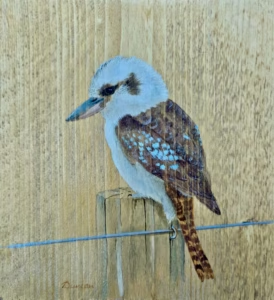 The choice to paint the kookaburra on oak wood is not incidental. Wood carries its own voice. It has lived, grown, weathered seasons. Its grain tells a story of time and resilience. When an animal is painted onto wood rather than canvas or paper, there is a sense of grounding, of something rooted and elemental.
In this case, the oak becomes a meeting place between two worlds. A European wood holds an Australian bird. Past and present, here and there, converge. For the recipient, this subtle layering can resonate deeply—even if they cannot articulate why.
Touch, too, plays a role. Wood invites a different kind of interaction. It feels solid, warm, real. It doesn’t sit behind glass; it stands as an object with presence. That physicality mirrors the emotional weight of connection and heritage.
Recognition Without Explanation
What was remarkable about this particular painting was the immediate emotional response it evoked. No long story was required. No written description could have enhanced what the viewer felt upon seeing it. The kookaburra simply spoke.
It spoke of childhood mornings. Of light filtering through eucalyptus leaves. Of laughter that belongs to a specific land and nowhere else. It reminded the viewer not just of where they came from, but of who they are beneath the layers of distance and time.
This is where art transcends decoration and becomes something closer to a companion. A painting like this doesn’t just hang on a wall; it keeps watch. It reassures. It quietly says, You belong. Your story matters. Your roots are alive.
Art as an Emotional Bridge
In a world saturated with text—emails, messages, explanations—we can forget how deeply we crave non-verbal connection. Paintings offer refuge from overthinking. They allow us to feel without justification.
For those living far from home, art can act as an emotional bridge, spanning continents in an instant. A single image can reconnect someone to their heritage more effectively than paragraphs of description ever could.
This is why meaningful art is so personal. Two people can look at the same painting and hear entirely different messages. The artist provides the doorway; the viewer brings their own story through it.
When Art Finds Its Home
Perhaps the most beautiful thing about a painting that truly speaks is that it feels like it has found its person. As artists, we may guide the brush, choose the subject, and shape the form—but once the work is complete, it begins a life of its own.
Duncan’s kookaburra on oak did exactly that. It travelled across meaning and memory to land where it belonged, offering comfort, connection, and a sense of home that words could never fully express.
And that is the quiet miracle of art: when it stops being something you look at, and becomes something that looks back—recognising you, reminding you, and speaking straight to your soul.
You can see more of Duncan’s art here and in particular his wooden art here.
Further Reading
- Learn more about the symbolic significance of the kookaburra and its cultural connections: About My Brain – Kookaburra Meaning & Significance: https://www.aboutmybrain.com/cards/spirit-animals-oracle-deck/kookaburra
- Explore how art fosters emotional connection and well-being: Psychology of Art & Human Connection: https://affordableartfair.com/inspiration/psychology-art-human-connection-guide/