As Duncan headed off to his home county his train journey turned into a bird watching expedition.
One half of the Skylark team recently left the south and migrated north for a small part of the winter. It might sound like an unusual choice at this time of year, but travel has a way of offering fresh perspectives, especially when you take the time to look out of the window rather than down at a screen.
I boarded the train with every intention of reading an interesting book I’d brought along. The kind of book you save for a quiet journey, imagining uninterrupted chapters and steady progress. But as soon as the train began to roll through open countryside, the book stayed mostly closed. Fields, rivers, hedgerows, and winter skies quickly proved far more compelling.
There’s something about travelling by train that encourages observation. You’re not responsible for steering or navigating, so your eyes are free to wander. The landscape slips past at just the right pace, slow enough to notice details but fast enough to keep surprising you. And winter, often dismissed as dull or lifeless, revealed itself as quietly abundant.
One of the first highlights was a Red Kite, unmistakable even at a distance, gliding effortlessly with its forked tail catching the light. It felt like a small gift to see one so clearly. Several Buzzards followed throughout the journey, some perched, others circling lazily overhead, scanning the ground below. Two Kestrels in different counties, hovered with remarkable precision, wings flickering as they held themselves almost motionless in the air.
The waterways were equally lively. Several Mallard ducks drifted across the surface of ponds and flooded fields, joined by Tufted ducks and Coots. In two different fields, Herons stood like grey statues at the water’s edge, utterly still, while another was observed rising into flight, wings beating slowly as it crossed the landscape. Moments like that make you realise how easy it is to miss beauty when you’re not paying attention.
Groups of Greylag Geese appeared alongside Canada Geese, scattered across fields and water. Two Mute Swans moved with quiet elegance, their white bodies stark against the darker winter colours. Even more special was a small flock of around eight Whooper Swans, their arrival bringing a real sense of seasonal change. Seeing them felt like a reminder that winter has its own rhythms and visitors.
The fields themselves were full of movement. A covey of eight Partridge darted across stubble, followed later by another group of ten, moving quickly and keeping close together. A small flock of Lapwing twisted and turned in flight, flashes of black and white catching the eye. Their movement felt joyful, almost playful, despite the cold season.
Above and across the fields, flocks of Starlings created ever-shifting patterns, while several groups of Fieldfare and Redwing dotted the land, busy feeding and resting as they make the most of winter resources. These seasonal visitors always bring a sense of connection to wider journeys happening far beyond the train tracks.
Rooks and Carrion Crows were constant companions along the route, intelligent and watchful, perfectly at home in farmland and woodland edges. Nearer home, on the right Tyne, Cormorants appeared near the water, dark and angular, some standing with wings spread drying themselves. Several Goosanders were a real pleasure to spot, sleek and striking, cutting through the water with purpose, effortlessly swimming against the flow of the river.
Then came a moment that felt particularly special: a Barn Owl, pale and almost ghostlike, gliding low over the land. It appeared briefly, and then was gone. It’s the sort of sighting that lingers in your mind, replaying itself long after the moment has passed.
Of course, no countryside journey would be complete without the familiar. Magpies flashed their black-and-white markings from hedgerows, and Wood Pigeons, part of the wider tapestry of life outside the window.
By the end of the journey, I realised I’d barely turned a page of my book. And that felt absolutely fine. Sometimes the best stories aren’t written in print but unfold quietly alongside you, if you’re willing to look.
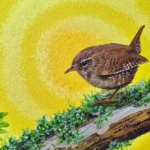
For a winter train journey, it was rich, varied, and unexpectedly inspirational. Proof that even in the colder months, the landscape is alive with movement, colour, and connection. Food for my creative soul! Watch this space for some paintings to come from this journey back to my home county of Cumbria.
I have a passion for birds and have built up quite a knowledge bank over many years, if you would like to identify the birds you see around you these websites may be useful:
Bird identifier
23 most common British birds
Duncan
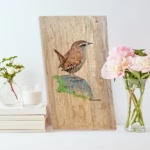
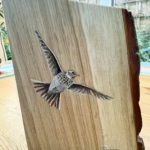
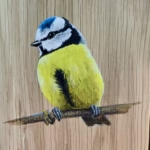
You can find some of Duncan’s bird art here: Flying Home Race to Roost & Birds on wood